Verkilo vs. Scrivener
You've outgrown Scrivener by book six.
Scrivener is good software. I used it for years, and if you're writing one book it will probably do everything you need.
The trouble starts with the second book, and it gets worse with the fifth. A series is one story told across ten files, and Scrivener has no idea the other nine exist. There is no place to put the thing that is true in all of them. So it ends up in your head, or in a spreadsheet, or nowhere, and somewhere around book six you stop writing for a whole afternoon because you cannot remember whether you killed someone.
That is the problem Verkilo was built for.
One project, every book
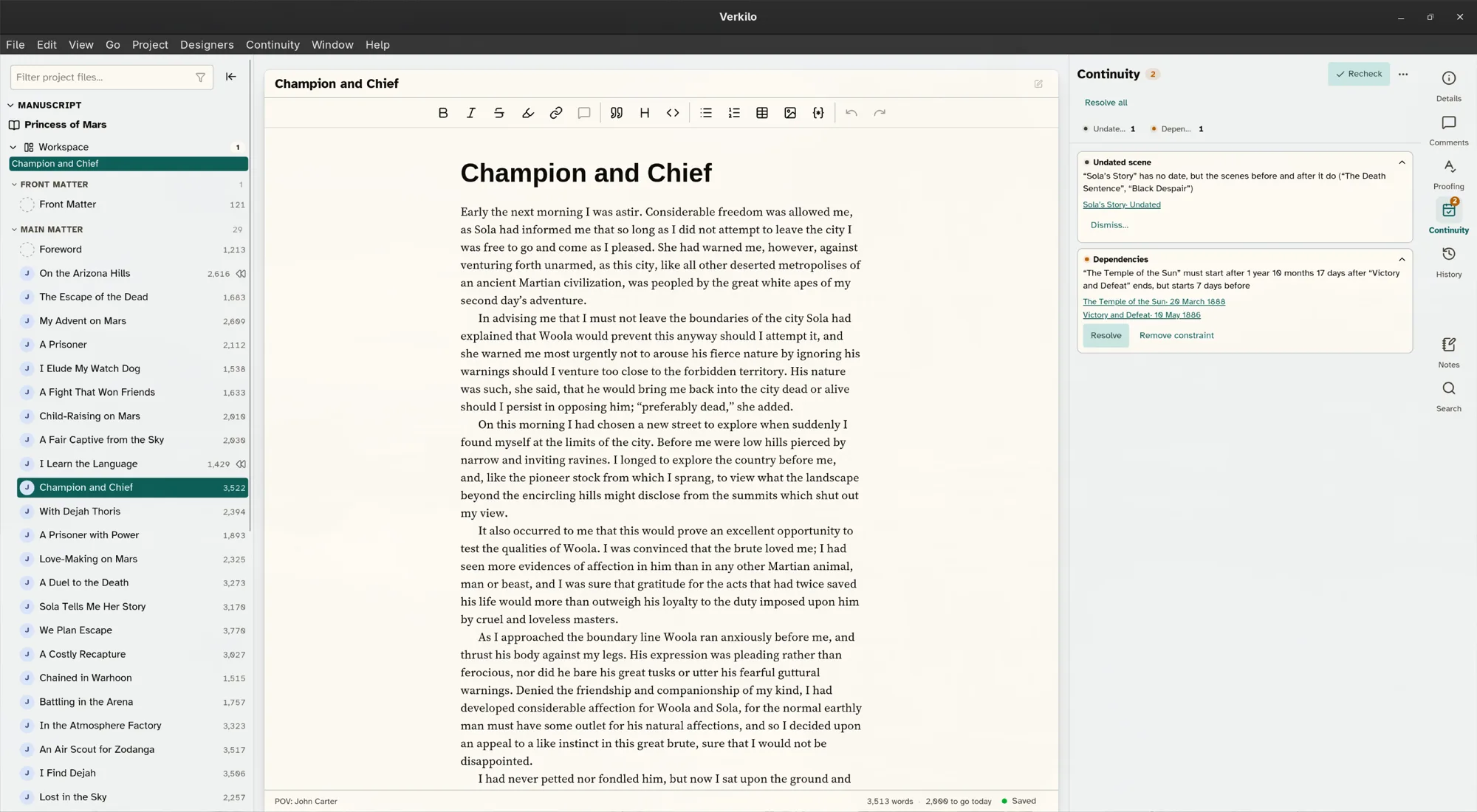
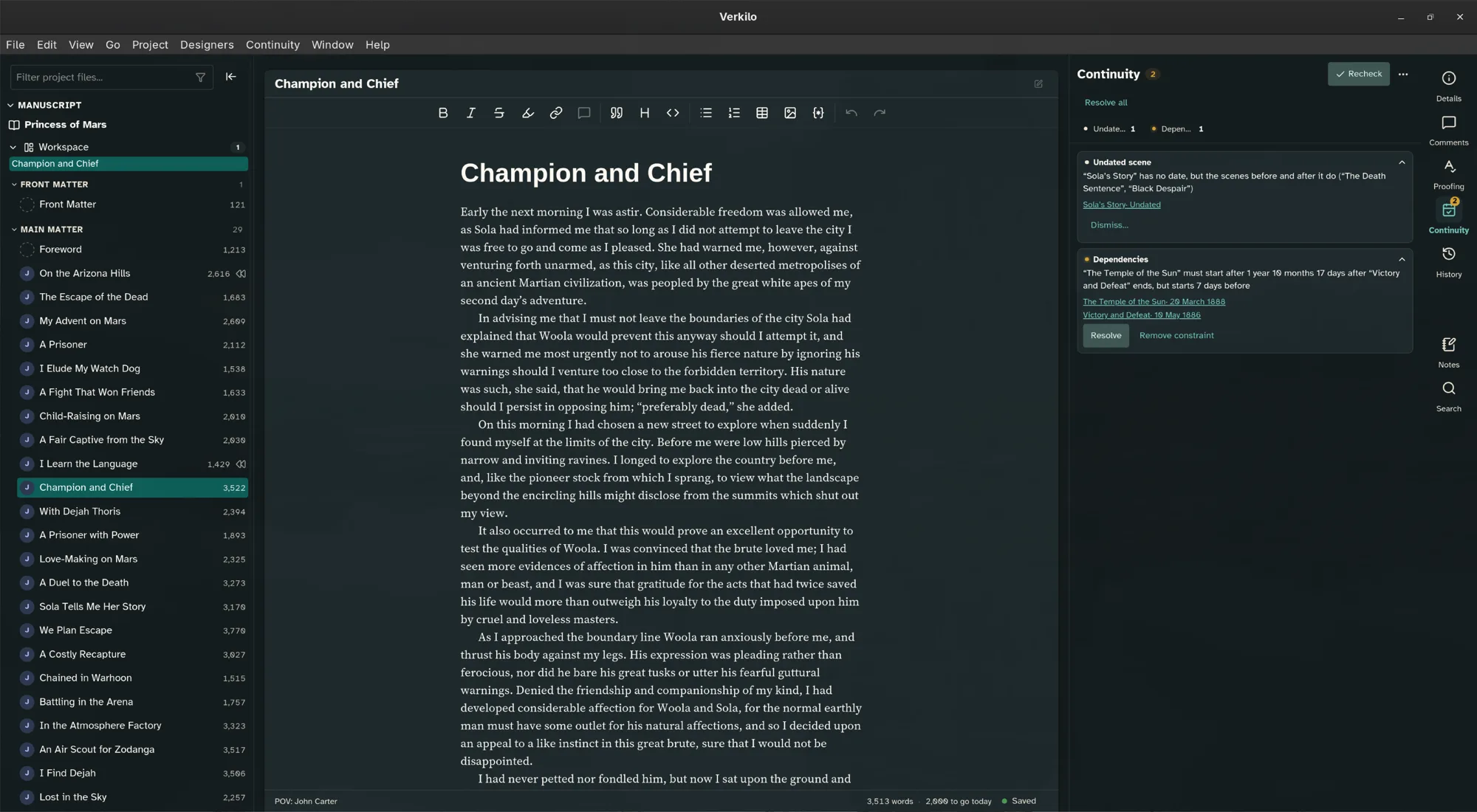
In Verkilo a series is the project and the books are inside it. They share one cast, one map, one set of items and one list of loose threads. Open book nine and the character you introduced in book two is already there, with every scene she has ever appeared in listed under her name.
The Series Bible is not a notes folder. Each entry is linked to the scenes it appears in, so when you change a character's rank you can see the four chapters that just became wrong.
Bring the series you already wrote
Verkilo opens Scrivener 3 projects. Point it at a .scriv bundle and that
book arrives as a book in your series, with its binder structure intact and its
characters and places pulled into the Series Bible.
It shows you exactly what it is going to do before it writes a thing. Every document it found, every character it recognized, every item it could not place. You read the list and then decide.
Do that once per book and a nine-book series that lived in nine separate files becomes one project.
One license, every computer you write on
Scrivener licenses per platform. The Mac version and the Windows version are separate purchases at $59.99 each, so if you draft on a desktop and revise on a laptop that is not the same machine, you buy it twice. iOS is a third purchase at $23.99.
One Verkilo license covers Mac, Windows and Linux.
It keeps working
Verkilo checks your license exactly once, when you activate it. After that it never asks again. Not for a feature, not for a login, not to confirm you're still allowed to open your own manuscript. Pull the network cable out and nothing changes.
Your manuscripts are files on your own disk, in a format you can read without me. And every build carries a sunset date: about ten years after I compile a release, that copy stops asking for a license key at all, with no network and nobody's permission. If Merovex Press goes away, the software you bought frees itself.
That is the part the cloud-hosted tools cannot match. Not because they are badly run, but because a subscription that keeps working after you stop paying is not a subscription.
Side by side
Verkilo and Scrivener, on the things that differ.
| Verkilo | Scrivener | |
|---|---|---|
| Price | $98 once | $59.99 per platform |
| Mac, Windows and Linux | One license covers all three | Mac and Windows licensed separately; no Linux |
| iPad | $23.99, bought separately | |
| Continuity across a whole series | Series Bible, linked to every scene | |
| Opens Scrivener 3 projects | ||
| Works offline, no account |
Scrivener prices read from Literature & Latte's own store on 2 October 2026. Verkilo against Atticus, Dabble and Vellum too.
Where Scrivener is still the better answer
Three cases, honestly.
If you are writing one standalone book, Scrivener does more than you need and Verkilo's whole advantage is irrelevant.
If you write on an iPad, Scrivener has an iOS app and Verkilo does not. Verkilo is a desktop application.
And if you have twenty years of Scrivener projects and a workflow you like, the cost of moving is real and I am not going to pretend otherwise. The import brings your words and your binder across. Muscle memory is not a file format.
Thirty days, the whole app, no card and no account.
Verkilo asks for a license key on day thirty-one. Until then every feature is open, and your books are files on your own computer whether you buy or not.
$98 once. No subscription, no renewal, no second invoice. Covers Mac, Windows and Linux.